
CAT 2027 Foundation Prep: How to Start a Year Out
Starting CAT 2027 prep a year out - foundation phase plan, mock cadence, weakest-section closure, daily routine.
Plan your next step
CAT 2027 is expected to be held on the last Sunday of November 2027 - based on the recent IIM pattern (CAT 2024: Nov 24; CAT 2025: Nov 30; CAT 2026: Nov 29), this places CAT 2027 on November 28, 2027 (Sunday). Registration historically opens in the first week of August (CAT 2026 registration opened August 1, 2026); the official notification with confirmed dates is released by the host IIM in the last week of July. For aspirants targeting 99+ percentile and top IIM admissions, starting structured prep 12 months out is optimal. This guide is for aspirants in penultimate year of B.Tech, final-year graduates, or working professionals who can commit to a 12-month structured prep cycle.
For broader CAT context, see our CAT Coaching in Coimbatore and CAT 2026 Syllabus + Section-wise Prep Guide.
Who is this article for?
This is for 12+ month-out CAT aspirants. Specifically:
- Penultimate-year B.Tech students (typically 3rd year) - can prep alongside academics for the CAT 2027 cycle
- Final-year graduates - have full time to dedicate to CAT prep
- Working professionals - can prep alongside work for next-year CAT cycle
- Repeat CAT aspirants - strong profile from previous cycle wanting structured 12-month re-prep
NOT for: cold starters (those with no prep + 6 months to CAT - see our How to Crack CAT in Last 2 Months guide for 60-day strategy).
Why 12+ months out is optimal
Three reasons:
1. Concept depth
CAT tests fundamental aptitude in VARC + DILR + QA. Concept depth requires sustained exposure - 12 months of structured study + practice deepens conceptual mastery beyond what 6-month or 3-month crash prep delivers.
2. Mock practice spread
CAT preparation benefits from 20-30 full-length mocks taken across the year. Compressed mock cycles (4-5/week in final 2 months only) deliver volume but lower per-mock learning quality. Spread mocks allow weekly analysis depth.
3. Weak-section closure time
The single most predictive intervention for percentile improvement is closing the weakest section. Closing a weak section requires 8-12 weeks of sustained focused work - 12+ months out provides this runway without compromising other sections.
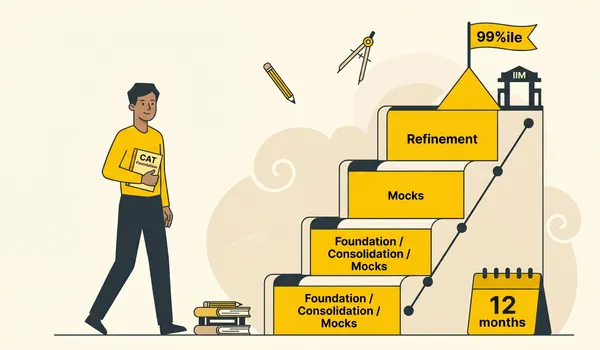
The 12-month phase plan
Phase 1: Foundation (Months 12-9 of prep)
Goal: complete concept coverage section by section + take first 2-3 diagnostic mocks.
Daily structure (typical, weekday + weekend):
- 4-6 hours/day of focused concept study
- Weekday evenings + weekend full-day for working professionals
- Penultimate-year students: 3-4 hours weekdays + 6+ hours weekends
Section-by-section coverage approach:
Months 12-11: VARC + QA fundamentals
- VARC: vocabulary builders, reading speed drills, para summary practice
- QA: arithmetic foundations (percentages, ratio, profit-loss, time-work-distance)
- Algebra basics (linear equations, inequalities)
- Read 30-45 min daily of high-quality non-fiction (The Economist, Aeon, Atlantic)
Months 11-9: DILR + advanced QA
- DILR: data interpretation set types (caselets, tables, graphs, Venn diagrams)
- Logical reasoning: arrangements, sequencing, puzzles
- QA: advanced topics - geometry, modern math (P&C, probability, set theory)
Mock cadence during foundation:
- Diagnostic mock at the start (Month 12): identifies weakest section
- 1 mock per month during Foundation phase
- Section-wise tests after each major topic
Phase 2: Concept Consolidation (Months 9-5 of prep)
Goal: complete all topic coverage + begin AIMCAT mock series + identify weak sub-topics.
Daily structure:
- 4-6 hours/day of structured study + practice
- Topic-wise tests weekly across covered subjects
- Began AIMCATs by Month 7
Section-wise focus this phase:
VARC consolidation (~25% of prep time):
- 4-5 RC passages per week from past CATs
- Para summary + para jumbles + odd-one-out daily practice
- Vocabulary building (8-12 new words per week from reading)
DILR consolidation (~30% of prep time):
- 3-4 DILR sets daily (timed: 10-12 minutes per set)
- Build personal solution templates for common set types
- Identify which set types you avoid + focus on them
QA consolidation (~35% of prep time):
- 30+ problems daily across Arithmetic + Algebra + Geometry
- Topic-wise weekly tests
- TITA strategy practice (no negative marking - attempt all)
Mock cadence:
- 1 mock per week (AIMCATs)
- Detailed post-mock analysis (45-60 min)
- Topic-specific tests biweekly
Phase 3: Mock-Heavy Phase (Months 5-2 of prep)
Goal: 2-3 full mocks per week + strategy refinement + close weak sections.
Daily structure:
- 5-7 hours/day on non-mock days
- Mock day: 2 hours mock + 60-90 min analysis + 2-3 hours additional drills
Mock cadence:
- 2-3 full-length AIMCATs per week
- Detailed analysis after each mock
- Topic-specific drills filling identified weak areas
Section attempts strategy refinement:
- Attempt order: VARC → DILR → QA vs other variants
- Time-allocation within each section
- Question-skipping discipline
Phase 4: Refinement Phase (Months 2-0 of prep)
Goal: lock in attempt strategy + build exam-day stamina + last-3-day preparation.
Final 8 weeks structure:
- Week 1-2: 4 mocks/week with rigorous analysis
- Week 3-6: 5-6 mocks/week + topic revision
- Week 7-8: Taper to 3-4 mocks/week + exam-day-condition simulation
For detailed last-2-month strategy, see our How to Crack CAT in Last 2 Months.
Daily routine across the 12 months
Working professional schedule:
- 06:00-07:30: Morning prep (1.5 hours; VARC reading + vocabulary)
- 07:30-09:00: Breakfast + commute
- 09:00-18:00: Work
- 18:00-19:00: Light dinner + break
- 19:00-22:00: Focused study (3 hours; QA + DILR section-specific work)
- 22:00-22:30: Light revision + sleep prep
Weekend: 6-8 hours focused study + 1 mock per week
Penultimate-year student schedule:
- 06:00-08:00: Morning prep (2 hours)
- 08:00-15:00: College classes
- 15:00-16:00: Lunch + break
- 16:00-20:00: Focused study (4 hours)
- 20:00-21:00: Dinner
- 21:00-22:00: Light revision
Weekend: 8+ hours focused study + 1-2 mocks
Full-time aspirant (graduate / gap year) schedule:
- 06:00-09:00: Morning prep (3 hours)
- 09:00-10:00: Breakfast + break
- 10:00-13:00: Concept study (3 hours)
- 13:00-14:00: Lunch
- 14:00-17:00: Topic-specific tests + practice
- 17:00-18:00: Exercise + break
- 18:00-19:00: Dinner
- 19:00-22:00: Mock analysis + light study (3 hours)
How to manage IELTS / GRE / work alongside CAT prep
For aspirants with parallel commitments:
IELTS / GRE alongside CAT:
- IELTS prep typically 2-3 months - can fit in any single month during Foundation phase
- GRE prep 3-4 months - fits between Foundation and Concept Consolidation
- Avoid taking IELTS / GRE simultaneously with CAT mock-heavy phase (Months 5-2)
Work alongside CAT (working professional):
- Foundation phase: 2-3 hours/weekday + 6-8 hours weekend
- Consolidation phase: 3-4 hours/weekday + 6-8 hours weekend
- Mock-heavy phase: take 1-2 days of leave per month for mock-day intensity
- Refinement phase: take 1-2 weeks of leave in final month if possible
Class XI-XII alongside CAT:
- Not recommended. Class XII board prep should be the focus during Class XII. Defer CAT prep to after boards (Feb-March) - most graduates can target the November CAT in their gap year.
How to identify weakest section early
By Month 11 of prep (after 2-3 mocks), you should have a clear sense of which section is weakest. Common patterns:
Engineering / science-track aspirants:
- Strong: QA
- Weak: VARC (reading speed, vocabulary range)
- DILR varies
Commerce / humanities-track aspirants:
- Strong: VARC
- Weak: QA (arithmetic, advanced topics)
- DILR varies
Closing the weakest section approach:
- Allocate 50-60% of weekly prep time to weakest section for 8-12 weeks
- Specific practice in the section's weakest sub-topics
- Sectional tests weekly with progress tracking
- Mock analysis weekly to confirm weak-section percentile improvement
What about Phase 1 / Phase 2 mock cadence?
| Month | Mocks per week | Total mocks through phase |
|---|---|---|
| Month 12 | 1 diagnostic | 1 |
| Month 11 | 1 | 4 (Foundation total) |
| Month 10 | 1 | 8 |
| Month 9 | 1 | 12 |
| Month 8 | 1.5 | 18 |
| Month 7 | 2 | 25 |
| Month 6 | 2 | 33 |
| Month 5 | 2 | 41 |
| Month 4 | 2.5 | 51 |
| Month 3 | 3 | 63 |
| Month 2 | 4 | 80 |
| Month 1 | 5 | 100 |
Total ~ 100 mocks over 12 months. Note: this is mock practice - most aspirants achieve 99+ percentile with 50-80 mocks; 100 is the upper end for those wanting maximum mock exposure.
Common foundation-stage mistakes
1. Rushing through concepts to reach mocks faster
Some aspirants compress concept study to 3-4 months to begin mock practice earlier. Result: weak conceptual foundation that surfaces during mock analysis. Solution: don't rush Foundation phase - depth matters more than speed.
2. Taking mocks too early without concept depth
Mocks before concept coverage is complete deliver demoralising low scores + don't surface meaningful learning. First proper mocks should come at Month 11-10 of prep.
3. Jumping prep books mid-stream
Switching from TIME materials to Arun Sharma to Manhattan Prep mid-prep disorients. Pick a primary source + supplement minimally.
4. Late VARC focus
VARC is the section that most rewards sustained reading practice. Starting VARC depth-focus only in Months 5-3 is too late. VARC should be daily practice from Month 12.
Related resources
Frequently asked questions
When does CAT 2027 happen?
Expected: November 28, 2027 (Sunday). IIM conducting body announces specific date in June-July 2027; registration expected to open August 1, 2027.
Should I take coaching from Month 12 or self-prep first?
Most 99+ percentile aspirants benefit from structured coaching from Month 12. Self-prep + later coaching can also work, but typically requires extra time + costs more in the long run. T.I.M.E. Coimbatore offers structured foundation programs starting Month 12.
Can I do this prep while working full-time?
Yes - but it requires 3-4 hours/weekday + 6-8 hours/weekend commitment. Many T.I.M.E. Coimbatore aspirants are working professionals who maintain this rhythm. The trade-off: longer prep cycles (15+ months for those starting from weaker baseline) or strategic leave during peak mock weeks.
What if I'm in penultimate B.Tech year?
Penultimate-year is the optimal start time. You have college classes (lower workload than final year), no major competing commitments, and 12+ months until CAT. T.I.M.E. Coimbatore's CAT prep for penultimate-year students is structured around this 12-month foundation.
How many AIMCATs should I take during Foundation?
1 mock per month during Months 12-9 (4 total). Diagnostic mock at Month 12 to identify weak section; 3 more during Foundation phase to track progress. The mock cadence ramps up significantly during Phase 2-3.
What's the typical percentile trajectory across 12 months?
| Month | Typical percentile |
|---|---|
| Month 12 (diagnostic) | 40-65 |
| Month 9 | 65-80 |
| Month 6 | 80-90 |
| Month 3 | 90-97 |
| Month 1 (final mocks) | 95-99+ |
These are typical trajectories. Strong starters can begin at 70-80 percentile and reach 99+ faster.
Can I prep for both CAT and XAT simultaneously?
Yes. XAT (early January, 5 weeks after CAT) shares ~70% conceptual overlap with CAT. Most serious CAT aspirants also write XAT - minimal additional prep is needed beyond CAT preparation. Add 1-2 XAT-specific mocks in the final month.
When should I start taking AIMCATs?
AIMCATs should begin by Month 8-7 of prep (after foundational concept coverage). Earlier AIMCATs (Month 12-10) are for diagnostic purposes only - don't read too much into them.
What's the realistic 99+ percentile prep duration?
12-18 months for most aspirants. Some strong starters reach 99+ with 8-10 months of intensive prep; others need 18+ months. The single most predictive variable is consistency, not absolute prep duration.