
CAT 2026 Syllabus: Section-wise Preparation Guide
CAT 2026 complete syllabus, VARC / DILR / QA section strategy, T.I.M.E. preparation approach, and the realistic timeline from prep to IIM admission.
Plan your next step
CAT 2026 is conducted by the IIMs in rotation; IIM Indore is expected to host CAT 2026 (official notification due late July 2026). Registration opens August 1, 2026; the exam is held on November 29, 2026. This guide covers the complete CAT 2026 syllabus across all 3 sections, section-wise preparation strategy, and the realistic timeline from prep start to IIM admission.
For broader CAT-prep guidance specific to Coimbatore, see our CAT Coaching in Coimbatore guide and the coaching hub.
CAT 2026 Overview
Exam structure:
- Total duration: 120 minutes
- Sections: 3 (VARC, DILR, QA)
- Sectional timing: 40 minutes per section, no inter-section navigation
- Total questions: ~66-72 (variation each year)
- Question types: MCQ (Multiple Choice - 4 options, -1 negative marking for incorrect) + TITA (Type In The Answer - numerical answer, no negative marking)
- Scoring: each correct +3, MCQ incorrect -1, TITA no negative
- Result format: raw score → percentile (computed across CAT slots)
Registration timeline:
- Application window: opens August 1, 2026 at iimcat.ac.in
- Admit card download: Late October
- Exam date: Late November / Early December (typically Sunday)
- Result announcement: First week of January 2027
Section 1: Verbal Ability and Reading Comprehension (VARC)
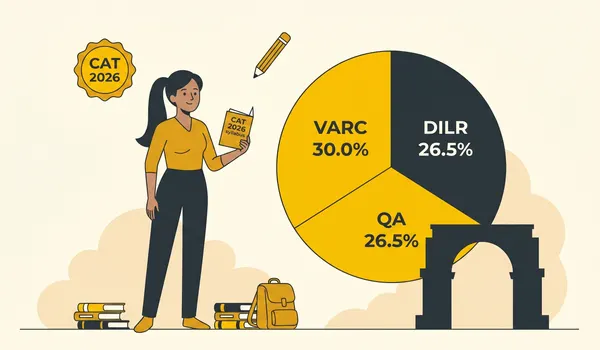
Duration: 40 minutes | Questions: ~22-24 | Weightage: ~33% of total
VARC syllabus
Reading Comprehension (~70% of VARC marks)
- 3-4 passages per CAT
- 14-16 questions across passages
- Topics span: contemporary issues, science, philosophy, economics, sociology, literature, history
- Question types: main idea, author tone, inference, vocabulary in context, specific detail, organisational pattern
Verbal Ability (~30% of VARC marks)
- Para Summary: pick the 4-sentence summary that best captures a given paragraph
- Para Jumbles: rearrange 4-5 sentences into a coherent paragraph
- Odd Sentence Out: identify the sentence that doesn't belong with others
- Sentence Completion / Coherent Insertion
VARC prep strategy
Reading speed + comprehension depth:
- Target: 200-300 words per minute reading speed with retention
- Practice: read 30-45 minutes daily of high-quality non-fiction (The Economist, Aeon, Atlantic, longform journalism)
- Build vocabulary in context (not flashcard memorisation) - 8-12 new words per week from reading
Mock-based pattern recognition:
- After 20+ RC passages from past CATs, identify your weak topic types (philosophy passages? economics? science?)
- Drill the weak passage type 2-3× more frequently
- Time per RC passage: aim for 7-9 minutes per passage with 4 questions
Verbal Ability mastery:
- Para Summary: practice 30+ from past CATs
- Para Jumbles: learn to identify connective patterns (pronouns, definite articles, transition words)
- Odd Sentence Out: identify thematic and tonal coherence
Section 2: Data Interpretation and Logical Reasoning (DILR)
Duration: 40 minutes | Questions: ~20-22 | Weightage: ~33%
DILR syllabus
Data Interpretation (~50% of DILR)
- Tables: complex data tables with multiple columns
- Graphs: bar, line, pie, area, mixed
- Caselets: paragraph-based DI with multiple variables
- Multi-source: combining 2-3 data sources
Logical Reasoning (~50% of DILR)
- Arrangements: linear, circular, grid-based seating
- Sequencing: temporal or logical order puzzles
- Distribution: matrix-based allocations
- Networks / family / venn diagrams
- Games: number-position based puzzles
DILR prep strategy
Set selection discipline:
- 5-6 sets typical per CAT, each with 4-6 questions
- First 5 minutes: scan all sets, identify the 4 sets you can solve, skip the hardest 1-2
- Common trap: starting with the first set without scanning → spending 15 minutes on the hardest set + running out of time
Set-type pattern recognition:
- After 50+ practice sets, recognise the set type within 30 seconds of seeing it
- Internalise solution templates for common set types (arrangement, distribution, graph-based)
- Practice timed sets: 10-12 minutes per set with 4-5 questions
Mock analysis:
- Post-mock: identify which set types you avoided + why
- Practice 2-3 sets per day of your weakest type
- Build a personal "set type fluency" rather than topic-wide DI/LR mastery
Section 3: Quantitative Aptitude (QA)
Duration: 40 minutes | Questions: ~22-24 | Weightage: ~33%
QA syllabus
Arithmetic (~50% of QA - historically the dominant cluster)
- Percentages, ratios, proportions
- Profit, loss, discount, mark-up
- Time, speed, distance (boats, trains, races)
- Time + work + pipes-cisterns
- Averages, mixtures, allegations
- Simple + compound interest
Algebra (~25%)
- Linear and quadratic equations
- Inequalities
- Functions (linear, quadratic, modulus)
- Number system + remainder theorems
- Sequences + series (AP / GP / HP)
Geometry + Mensuration (~15%)
- Triangles (similarity, congruence, special triangles)
- Circles + tangents + chords
- Quadrilaterals + polygons
- Coordinate geometry
- 3D mensuration (cuboids, cylinders, cones, spheres)
Modern Math (~10%)
- Set theory + Venn diagrams
- Permutation + Combination
- Probability (basic and conditional)
- Logarithms (computational use)
QA prep strategy
Arithmetic dominance:
- ~50% of QA marks come from Arithmetic - make this your strongest area
- Master percentages, ratios, time-speed-distance, and time-work as foundational
- Solve 30+ problems daily on these topics during initial 3 months
Algebra + Geometry depth:
- Build conceptual depth over volume - quality of practice matters more than raw count
- For each topic, solve past-CAT problems first, then NCERT-level reinforcement, then advanced material
- Geometry: learn to identify similar triangles, key theorems (Pythagoras, Apollonius, etc.) by problem type
TITA strategy:
- TITA questions (Type In The Answer) have no negative marking - attempt all TITA questions if you can rule out gibberish answers
- Target 8-10 TITA attempts per CAT QA section
Time-per-question discipline:
- Average 1:50 per question; some easier questions in 30-45 seconds; harder ones up to 3 minutes
- Skip rule: if no progress in 90 seconds, mark and move on
Section-wise weak-section closure
The single most predictive intervention for percentile jumps: closing the weakest of the 3 sections.
If VARC is your weakest:
- 30-45 minutes daily structured reading (non-fiction)
- 10+ RC passages per week from past CATs
- Vocabulary builders + para-summary daily practice
- Target: weakest-section percentile within 5 points of best-section percentile
If DILR is your weakest:
- 2-3 sets daily (timed, 10-12 minutes each)
- Mock analysis on which set types you avoid + targeted practice on those
- Build personal solution templates for common set types
If QA is your weakest:
- 30+ problems daily across Arithmetic + Algebra + Geometry
- Strong on Arithmetic (50% weightage) - make this your highest-confidence area
- Topic-wise tests weekly; mock-based practice in final 2-3 months
Realistic CAT 2026 timeline
June-July 2026: Foundation phase
- Choose batch type at T.I.M.E. Coimbatore (classroom / weekend / online live)
- Diagnostic mock: identify starting baseline + weakest section
- Begin section-wise concept coverage
- Target: complete VARC + QA fundamentals; begin DILR set-type recognition
August-September 2026: Concept consolidation
- Complete topic-wise tests across all 3 sections
- CAT registration (typically August)
- Begin AIMCAT mock series - 1 mock per week initially
- Focus on weak-section closure
October-November 2026: Mock-heavy phase
- 2-3 mocks per week with structured analysis
- Refine attempt-order and section-strategy
- Practice section-specific tests on weak areas
- Target percentile: consistent 90+ in mocks indicating 95+ CAT readiness
Last 2 weeks before CAT:
- 4-5 mocks per week
- Exam-day-condition simulation (timing, breaks, breakfast)
- Avoid new topics; consolidate strengths
- Final mental and physical preparation
For detailed final-month tactics, see How to Crack CAT in the Last 2 Months.
Related resources
- CAT exam preparation hub
- CAT coaching in Coimbatore
- How to crack CAT in last 2 months
- CAT vs MAT vs XAT vs CMAT comparison
Frequently asked questions
When does CAT 2026 registration open?
August 1, 2026 at iimcat.ac.in; the exam itself is on November 29, 2026. T.I.M.E. Coimbatore provides registration guidance and verification support.
What's the CAT 2026 fee?
INR 2,600 for general category; INR 1,300 for reserved categories (SC / ST / PwD). Payment online during the registration window.
How many times can I take CAT?
No limit - CAT can be attempted multiple times in different years. Each year's CAT is a fresh application + fresh fee. Most aspirants attempt CAT 1-3 times; some serious aspirants make 4+ attempts across years.
Does CAT 2026 have any syllabus changes from previous years?
Major syllabus changes typically don't happen between CAT years. Small structural variations (number of TITA vs MCQ; passage length; set complexity) vary slightly each year based on the conducting IIM's preference. The 3-section format with sectional timing has been stable since 2014-15.
Can I take CAT 2026 as a final-year B.Tech student?
Yes - final-year graduates are eligible to take CAT and receive offers from IIMs and other B-schools conditional on graduation by the program's start date. Most CAT aspirants are final-year graduates or those with 0-2 years of work experience.
What's the IIM admission process post-CAT?
CAT score is the gateway; IIMs use a multi-stage process:
- 01.Sectional + overall cutoff for shortlisting to WAT/PI
- 02.WAT (Written Ability Test) + PI (Personal Interview) at each IIM
- 03.Composite score combining CAT, profile (academics, work experience), WAT/PI
- 04.Final admission offer
T.I.M.E. Coimbatore provides WAT/PI prep from late January through March each year.
How does CAT 2026 compare with previous years' difficulty?
CAT difficulty has been moderately stable since 2015 with small year-on-year variations. The 2020 COVID-era CAT had reduced duration (40 min per section, vs earlier 60); this has remained the format since. Expect similar overall difficulty to CAT 2023-25 for CAT 2026.
What if I don't crack CAT 2026?
Options: (1) retake CAT in 2027 with improved prep, (2) target tier-2 B-schools via MAT / CMAT / XAT, (3) consider international MBA via GMAT, (4) pursue specialized programs (FMS for marketing, MDI Gurgaon for general management). Most aspirants who eventually crack CAT have attempted it 2-3 times.