
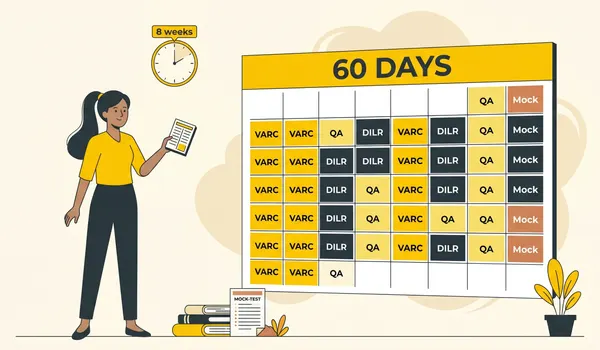
How to Crack CAT in Last 2 Months: Daily Schedule
Final 8-week CAT preparation strategy - daily schedule, mock cadence, section-wise focus, exam-day execution, and what NOT to do.
Plan your next step
The final 8 weeks before CAT are where structured year-long preparation translates into a competitive percentile - or doesn't. This guide is for two audiences: (a) aspirants in months 11-12 of structured prep with specific weak areas remaining, and (b) late-starters with strong foundation in 2 of 3 sections who need a focused final push. It is NOT for cold-starters with zero prep - 8 weeks isn't sufficient to build CAT competence from scratch.
For broader CAT preparation context, see our CAT Coaching in Coimbatore and CAT 2026 Syllabus guide.
Where you should be at T-60 days
Before entering the final 8-week framework, you should have:
- Completed concept coverage across all 3 sections (VARC, DILR, QA)
- Taken 10-15 full-length AIMCATs or equivalent mocks
- Identified your weakest section + 2-3 weakest sub-topics
- Established baseline percentile trajectory (where you score consistently in mocks)
- Comfortable with the 3-section, 40-minute-per-section sectional timing
If you're missing any of these, the 8-week framework needs adjustment - front-loading weeks 1-2 with additional concept coverage rather than mock-heavy work.
The 8-week framework
Weeks 1-2: Diagnose and Fix
Goal: identify the weakest section + 2-3 weakest sub-topics + commit to closing them.
Daily schedule (typical 6-day routine; 1 rest day):
- 06:30-08:00: Reading / VARC practice (newspaper + 1-2 RC passages)
- 08:00-09:00: Breakfast + commute
- 09:00-12:00: Weakest section deep-dive (3 hours)
- 12:00-13:00: Lunch + light reading
- 13:00-15:00: Second-weakest section practice (2 hours)
- 15:00-15:30: Tea + break
- 15:30-17:00: Strongest section maintenance (1.5 hours)
- 17:00-18:00: T.I.M.E. classroom session / doubt clearing
- 18:00-19:00: Dinner
- 19:00-21:00: Mock analysis or topic-specific test
- 21:00-22:00: Light revision + planning next day
Weekly cadence:
- 2 full-length mocks per week (timed, exam-day conditions)
- 1 detailed post-mock analysis session per mock (45-60 minutes - more important than the mock itself)
- 2 sectional tests on weakest section
- 1 sectional test on second-weakest section
- 1 day off for rest + recovery
Mock analysis discipline:
- Identify which questions you got wrong vs got right by luck
- Identify questions you skipped that you could have attempted
- Time spent per question (outliers >3 minutes = strategy failure)
- Topic-wise accuracy distribution (which DILR set types? which QA sub-topics?)
Weeks 3-4: Section Deep-dive
Goal: close the weakest section by 5-8 percentile points; bring second-weakest up to par.
Adjusted daily schedule:
- Increase weakest-section focus to 4 hours/day (split across morning + evening)
- 2 hours on second-weakest section
- 1 hour maintenance on strongest section
Weekly cadence:
- 2-3 full-length mocks per week
- Sectional tests focused on weak sub-topics
- Past-CAT problem sets by topic (e.g., for QA: focus on Arithmetic and Algebra past-CAT problems)
Section-specific tactics:
VARC weak-section closure:
- 4-5 RC passages daily from past CATs (timed: 7-9 minutes per passage)
- Para summary + para jumble practice (10 questions daily)
- Vocabulary in context (5-8 new words daily from reading)
- Reading speed drills (target 250-300 wpm with retention)
DILR weak-section closure:
- 3-4 sets daily (timed: 10-12 minutes per set)
- Focus on set-type pattern recognition
- Common weak areas: caselets, multi-source DI, complex arrangements
- Build personal solution templates for the set types you avoid
QA weak-section closure:
- 30-40 problems daily across Arithmetic + Algebra + Geometry
- Strong on Arithmetic (50% of QA marks)
- TITA practice (no negative marking - attempt all TITAs)
- Time-per-question discipline (1:50 average, skip after 90 seconds with no progress)
Weeks 5-6: Mock-heavy Phase
Goal: 4 mocks/week with rigorous analysis; refine attempt-order and time-management strategies.
Adjusted schedule:
- Mock days: full mock in morning, analysis in afternoon (60-90 minutes), rest in evening
- Non-mock days: weak-area drills + topic revision (~6 hours focused work)
Strategy testing in mocks:
- Test attempt-order strategies (start with strongest section vs weakest; VARC first vs QA first)
- Test time-allocation strategies (3 sections × 40 min: standard; or scan all sets at start of DILR before solving)
- Test question-skipping discipline (move on if no progress in 60-90 seconds)
Mock analysis (most important habit):
- 60-90 minutes per mock
- Categorise every question: got right, got wrong, skipped, got right by luck, got wrong despite effort
- Identify which 2-3 sub-topics consistently produce errors → targeted practice on these in non-mock days
Weeks 7-8: Refinement Phase
Goal: lock in attempt strategy; build exam-day stamina; avoid new topics.
Last 2 weeks of prep:
- 4-5 mocks per week (Sun, Tue, Thu, Sat typical)
- Each mock followed by analysis
- Strategy: NO new topics in last 2 weeks
- Strategy: only revision of strong topics + maintenance on weak
Exam-day-condition simulation:
- Mocks at the same time as actual CAT (3:00 PM or 9:00 AM slot)
- Same breakfast, same hydration pattern, same break behavior
- Same handwriting / scratch-paper format (CAT provides 1 scratch sheet)
Mental + physical preparation:
- Sleep schedule: minimum 7 hours; consistent bedtime + wake time
- Physical exercise: 30 min daily (walk, yoga, light cardio)
- Diet: avoid heavy meals on mock days; light, energy-sustaining food
- Stress management: 10 min meditation or breathing exercise daily
Last 3 days before CAT
Day T-3:
- One light mock (45-minute revision rather than full intensity)
- Review your final attempt strategy
- Pack exam-day kit: admit card, ID proof, transparent water bottle, comfortable clothes
- Verify exam centre location + transport plan
Day T-2:
- No new content
- Light review of one strong topic per section (build confidence)
- Early dinner
- Sleep target: 7+ hours
- Avoid caffeine after 4 PM
Day T-1:
- Complete rest day
- No mocks, no problems
- 20-30 min walking
- Verify admit card + ID + exam kit
- Sleep target: 7-8 hours
- No late-night cramming
Exam Day:
- Wake up early enough for breakfast + 15-min mental preparation
- Reach exam centre 60+ minutes early
- Hydrate (but don't overhydrate)
- Carry water bottle + admit card + ID
- Don't talk to other candidates about CAT prep topics in the waiting area
- Trust your prep strategy; execute as practiced
Exam-day execution strategy
Section attempt order (decide in mocks before exam):
- Most aspirants follow VARC → DILR → QA (the system-default order)
- Some choose to attempt strongest section first (build confidence) or weakest section first (deal with the hardest while fresh)
- Either approach works - execute the one you've practiced
Within each section:
VARC (40 min):
- 5 min: scan all RC passages to identify your best fit
- 25-28 min: solve 3 RC passages (~8-9 min each)
- 8-10 min: verbal ability (para summary, para jumble, odd-one-out)
- Don't get stuck on any single question >2 min
DILR (40 min):
- 5 min: scan all sets, identify the 4 sets you can solve
- 25-28 min: solve those 4 sets (~6-7 min per set)
- 5-7 min: revisit one easier set you initially deprioritized
- Skip the hardest 1-2 sets entirely
QA (40 min):
- 35 min: solve questions in order of confidence (skip difficult ones initially)
- 5 min: revisit skipped TITAs (no negative marking - guess if you can rule out wrong options)
- Discipline: 90 seconds per question max; skip if no progress
What NOT to do in the last 2 months
Five common mistakes that wreck final-month prep:
1. Taking 8 mocks per week without analysis. Mock-volume optimisation is a trap. 2-3 mocks per week with rigorous post-mock analysis beats 6 mocks per week without analysis.
2. Switching prep books or coaching last-minute. Last-month switching disorients your prep continuity. Trust your existing material; deepen rather than diversify.
3. New-topic exploration. Adding a new topic in week 7 introduces new uncertainty without time to consolidate. Stick to known territory.
4. All-nighters before mocks or exam. Sleep debt destroys mental sharpness - the opposite of what CAT requires. Maintain 7+ hour sleep schedule consistently.
5. Obsessing over absolute mock scores. Mocks are calibration tools, not predictors. A 88-92 mock percentile range is consistent with 95-99 CAT percentile range. Don't panic at individual mock dips.
Related resources
- CAT exam preparation hub
- CAT 2026 syllabus + section-wise prep
- CAT coaching in Coimbatore
- AIMCAT and other mock series: how to maximise your score
Frequently asked questions
Is 2 months enough to crack CAT from scratch?
No - 2 months is sufficient only if you have a strong foundation (10+ months prior structured prep). For cold-starters with zero prep, 2 months produces 50-70 percentile typically, not competitive for IIM admissions.
How many mocks should I take in the last 2 months?
20-25 full-length mocks across 8 weeks (~2-3 per week initially, ramping to 4-5 per week in final 2-3 weeks). Quality of analysis matters far more than volume.
Should I do GD/PI preparation alongside CAT in last 2 months?
No - GD/PI prep should be deferred until after CAT. The CAT itself is the gateway; GD/PI matters only after you receive shortlist calls (January-February). Focus on CAT in the final 2 months.
How do I handle test anxiety?
Mock practice in exam-day conditions is the most effective anxiety reducer - repeated exposure to the format normalizes the actual exam. Specific techniques: deep breathing during sectional transitions, pre-defined attempt strategy (reduces in-exam decisions), and not comparing yourself to other candidates in the waiting area.
What if my mock percentile drops in last 2 months?
Common pattern - most aspirants experience 1-2 mock-percentile dips in final weeks. Don't panic. The trajectory across 8-10 mocks matters more than any single mock. Continue the framework; the trend typically corrects with sustained analysis.
Can I prepare alone or do I need T.I.M.E. faculty access?
Both work. Strong self-preppers with disciplined mock analysis can achieve 95+ percentile. T.I.M.E. Coimbatore adds value through (a) doubt-clearing on stuck topics, (b) attempt-strategy refinement based on past student patterns, (c) post-mock analysis sessions, (d) accountability of structured batches.
What if I score lower than my mock average on actual CAT?
Happens. Possible reasons: exam-day anxiety, slightly harder paper, time-management slips. The post-CAT response: (1) take XAT (5 weeks later) with same prep, (2) consider retaking CAT next year with refined prep, (3) target tier-2 schools via MAT / CMAT.
Should I attempt all questions on CAT?
No - attempt all TITAs (no negative marking) but skip MCQs where you can't eliminate options. Typical strong scorers attempt 60-75% of questions with high accuracy rather than 90% with low accuracy. Accuracy beats volume in CAT.