
GATE 2027: Syllabus, Pattern, Subject-wise Strategy
GATE 2027 complete syllabus across branches, exam pattern, subject weightages for CSE / ECE / ME / CE / EE, and T.I.M.E. Coimbatore prep approach.
Plan your next step
GATE 2027 will be conducted by IIT Madras (confirmed). The exam is held tentatively in the first week of February 2027 across multiple weekends. The exam offers ~30 papers across engineering and science branches; this guide focuses on the most popular engineering branches (CSE, ECE, ME, CE, EE) for Indian B.Tech graduates. Coverage includes the complete syllabus structure, subject weightages, and prep strategy.
For broader GATE-prep guidance specific to Coimbatore, see our GATE Coaching in Coimbatore guide and the coaching hub.
GATE 2027 Overview
Exam structure:
- Total duration: 180 minutes
- Total questions: 65
- Total marks: 100
- Question types: MCQ (Multiple Choice - 4 options, -1/3 or -2/3 negative marking), MSQ (Multiple Select - no negative marking), NAT (Numerical Answer Type - no negative marking)
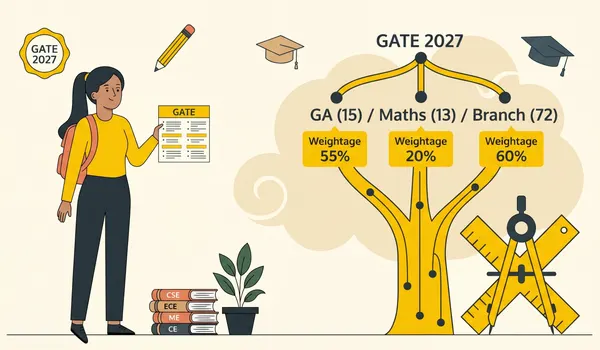
- Sections: General Aptitude (15 marks) + Engineering Mathematics (~13 marks) + Branch-specific Engineering Subjects (~72 marks)
Registration timeline:
- Application window: opens August 2026 (notification expected July 2026); extended period with late fee runs into October 2026 via the GOAPS portal at gate.iitm.ac.in
- Admit card download: January 2027
- Exam date: Early February 2027 (typically across multiple weekends)
- Result announcement: Mid-March 2027
Score validity: GATE 2027 scorecard valid for 3 years (until 2030) for M.Tech admissions, PSU recruitment, and PhD applications.
General Aptitude (15 marks across all papers)
Common section regardless of branch:
Verbal Aptitude (~7-8 marks)
- English grammar (subject-verb agreement, parallel structure)
- Sentence completion + vocabulary
- Verbal analogies + word groups
- Paragraph instructions + reading comprehension
Numerical Aptitude (~7-8 marks)
- Number relations + arithmetic operations
- Percentages, ratios, proportions
- Data interpretation (basic graphs, tables)
- Mensuration + geometry (basic)
- Logical reasoning + sequences
GA is the highest-yield section for time invested - relatively low difficulty, high marks, doesn't require deep technical knowledge.
Engineering Mathematics (~13 marks across most papers)
Common to all engineering papers (slight variations in specific topics):
- Linear Algebra: matrices (rank, eigenvalues, eigenvectors), systems of linear equations, vector spaces
- Calculus: limits, continuity, differentiation, integration (single and multiple), partial derivatives, gradient/divergence/curl
- Differential Equations: first-order ODEs (linear, exact, homogeneous), second-order ODEs (constant coefficient), partial differential equations (basic)
- Probability + Statistics: probability distributions (binomial, Poisson, normal), random variables, hypothesis testing
- Complex Variables: complex numbers, analytic functions, Cauchy-Riemann equations, residue theorem (for some branches)
- Numerical Methods: bisection, Newton-Raphson, numerical integration (Simpson's rules)
- Transform Calculus: Laplace transforms, Fourier series (for branches like CSE, ECE)
Strong Engineering Math performance is the most consistent differentiator between top-rank and mid-rank GATE scorers - these 13 marks are most predictable and reward sustained practice.
Branch-specific syllabi
Computer Science (CSE)
Subject weightage from past 5 years analysis:
| Subject | Marks (typical) | Priority |
|---|---|---|
| Algorithms | 8-10 | Top |
| DBMS | 6-8 | Top |
| Operating Systems | 5-7 | Top |
| Computer Networks | 5-7 | Top |
| Theory of Computation | 4-6 | Important |
| Compilers | 4-5 | Important |
| Computer Organization | 5-7 | Important |
| Programming + Data Structures | 6-8 | Top |
| Discrete Mathematics | 4-6 | Important |
| Digital Logic | 3-5 | Lower-priority |
Prep priority order:
- 01.Algorithms + Data Structures + Programming (combined ~14-18 marks)
- 02.DBMS + Computer Networks + OS (combined ~16-22 marks)
- 03.Theory of Computation + Compilers
- 04.Computer Organization + Discrete Math + Digital Logic
Electronics and Communication (ECE)
Subject weightage from past 5 years:
| Subject | Marks (typical) |
|---|---|
| Signals and Systems | 8-10 |
| Communication Systems | 8-10 |
| Electromagnetics | 6-8 |
| Control Systems | 6-8 |
| Electronic Devices | 5-7 |
| Digital Circuits | 6-8 |
| Analog Circuits | 5-7 |
| Network Theory | 4-6 |
Prep priority order:
- 01.Signals & Systems + Communication Systems (combined ~16-20 marks)
- 02.Digital Circuits + Analog Circuits + Electronic Devices
- 03.Electromagnetics + Control Systems
- 04.Network Theory
Mechanical Engineering (ME)
Subject weightage:
| Subject | Marks (typical) |
|---|---|
| Strength of Materials | 6-8 |
| Theory of Machines | 5-7 |
| Manufacturing Processes | 6-8 |
| Thermodynamics | 6-8 |
| Heat Transfer | 5-7 |
| Fluid Mechanics | 6-8 |
| Engineering Mechanics | 4-6 |
| Industrial Engineering | 3-5 |
| Material Science | 3-5 |
Prep priority order:
- 01.Strength of Materials + Engineering Mechanics
- 02.Thermodynamics + Heat Transfer + Fluid Mechanics (combined ~17-23 marks)
- 03.Manufacturing Processes
- 04.Theory of Machines
Civil Engineering (CE)
Subject weightage:
| Subject | Marks (typical) |
|---|---|
| Geotechnical Engineering | 8-10 |
| Structural Engineering | 8-10 |
| Transportation Engineering | 6-8 |
| Water Resources + Hydrology | 6-8 |
| Environmental Engineering | 5-7 |
| Construction Materials + Management | 4-6 |
| Surveying | 4-6 |
| Engineering Mechanics | 4-6 |
Prep priority order:
- 01.Geotechnical + Structural (combined ~16-20 marks)
- 02.Transportation + Water Resources
- 03.Environmental + Construction Materials
- 04.Surveying + Engineering Mechanics
Electrical Engineering (EE)
Subject weightage:
| Subject | Marks (typical) |
|---|---|
| Electrical Machines | 8-10 |
| Power Systems | 8-10 |
| Power Electronics | 6-8 |
| Control Systems | 6-8 |
| Electric Circuits | 5-7 |
| Signals + Systems | 4-6 |
| Electromagnetic Fields | 4-6 |
| Measurements + Analog Electronics | 4-6 |
Prep priority order:
- 01.Electrical Machines + Power Systems (combined ~16-20 marks)
- 02.Power Electronics + Control Systems
- 03.Electric Circuits + Signals & Systems
- 04.Electromagnetic Fields + Measurements
What the EE syllabus actually covers. Electrical Machines runs from single-phase and three-phase transformers and their equivalent circuits through DC machines, three-phase induction motors and synchronous machines. Power Systems covers load flow, symmetrical and unsymmetrical fault analysis, protection and switchgear, stability, and economic dispatch. Power Electronics is the device characteristics plus the rectifier, chopper and inverter chain built on them. Control Systems follows the standard time-response, root-locus, frequency-response and state-space progression. Electric Circuits, Signals and Systems, Electromagnetic Fields, Analog and Digital Electronics, and Electrical and Electronic Measurements make up the remainder. Engineering Mathematics carries its own ~13 marks on top of all of this, so an EE candidate is preparing eleven bodies of material, not eight.
Where EE candidates typically lose marks. Electrical Machines and Power Systems together are the largest block in the paper and also the two most commonly left half-finished, because both reward worked numerical practice rather than reading. Electromagnetic Fields is the usual first casualty of a compressed timetable; at 4-6 marks that is a defensible trade, but only after the top block is genuinely secure.
How to use the syllabus structure for prep planning
Phase 1: Diagnostic + foundation (Months 1-3)
- Take a baseline diagnostic mock to identify weak subjects
- Begin with the highest-weightage subjects in your branch (per the tables above)
- Build conceptual depth - don't rush through subjects for breadth
- Complete subject-wise tests at the end of each major subject
Phase 2: Concept consolidation (Months 4-7)
- Continue subject coverage; revisit weak subjects with extra depth
- Begin solving past-year GATE problems by subject
- Topic-wise tests weekly across covered subjects
- T.I.M.E. Coimbatore branch-specific faculty cover concept doubts
Phase 3: Mock-heavy phase (Months 8-12, October-January)
- 1-2 full-length mocks per week initially, ramping to 3-4 per week in final 2 months
- All-India test series ranking (compare with national cohort)
- Subject revision in priority order, avoiding entirely new topics
- Last 4 weeks: full-length mocks every other day, exam-day-condition simulation
For final-month tactics, see GATE 2027 Last Month Strategy.
Cutoff and outcome map
GATE cutoffs (qualifying marks) and rank-to-outcome map vary by branch. Approximate ranges:
GATE 2026 official qualifying cutoffs (general category):
- CSE: 30
- ME: 25.2
- EE: 27.7
- ECE: 26.4
- CE: 28.7
Category-specific cutoffs are lower (e.g., GATE 2026 CSE: 27 for OBC-NCL / EWS, 20 for SC / ST).
Score-to-outcome map (approximate, CSE branch):
| Score range | Likely outcome |
|---|---|
| 75+ (rank under 200) | Top IIT M.Tech (Bombay, Delhi, Madras, Kanpur, Kharagpur) |
| 65-75 (rank 200-500) | Other IIT M.Tech (Roorkee, BHU, Guwahati); top PSUs |
| 55-65 (rank 500-1500) | New IITs M.Tech; major PSU offers |
| 45-55 (rank 1500-5000) | Top NIT M.Tech via CCMT |
| 35-45 (rank 5000-15000) | Tier-2 NIT M.Tech; some PSU consideration |
| 25-35 (qualifying band) | Qualification certificate; smaller institutes |
Related resources
- GATE exam preparation hub
- GATE 2027 last-month strategy + subject-wise revision
- GATE coaching in Coimbatore
Frequently asked questions
When does GATE 2027 registration open?
Registration opens in August 2026 via the GOAPS portal at gate.iitm.ac.in. Notification expected July 2026. T.I.M.E. Coimbatore provides registration guidance + document verification support.
What's the GATE 2027 fee?
INR 900 per test paper (general/OBC) during the regular application period; INR 1,400 per test paper if applying during the extended period with late fee. Reduced rates apply for female / SC / ST / PwD applicants. Two papers in a single year doubles the per-paper fee.
Can I take GATE 2027 in two papers?
Yes - since GATE 2022, candidates can take two papers in a single year if the syllabi don't conflict (e.g., CS + DA). Two papers require additional prep time and are typically pursued only by candidates with strong baseline + specific career pathways.
How does GATE 2027 differ from previous years?
The exam pattern has been stable since 2014-15. The main 2024+ changes were the addition of newer papers (DA - Data Science and AI; ES - Environmental Science). Engineering branch papers (CSE, ECE, ME, CE, EE) have stable syllabi with minor topic adjustments year-over-year.
Should I focus on Engineering Math first or branch subjects?
Both in parallel. Engineering Math (13 marks) is the most consistent yield-per-effort area; branch subjects (72 marks) represent the bulk of the exam. Strong GATE preparation builds both simultaneously rather than sequencing them.
Can I crack GATE 2027 as a final-year B.Tech student?
Yes - most GATE aspirants are final-year B.Tech students or recent graduates. The exam pattern is structured around B.Tech curriculum subjects, so currency with these subjects (final-year revision + GATE-specific prep) is the natural fit.
What's the role of NAT questions?
Numerical Answer Type questions have no negative marking - attempt all NAT questions if you can rule out blatantly wrong answers. Typically 25-35% of GATE marks come from NAT.
Are there changes to PSU GATE-based recruitment?
PSU GATE-based recruitment continues at major PSUs (NTPC, ONGC, IOCL, GAIL, BHEL, BPCL, etc.). Specific PSU recruitment timelines + offers vary year-over-year. T.I.M.E. Coimbatore's placement cell tracks active PSU recruitment cycles for current students.
Should I prepare for ESE (Engineering Services) alongside GATE?
Some aspirants do - UPSC ESE shares conceptual overlap with GATE but emphasises descriptive answers (technical writing). ESE is competitive (top 100-300 ranks for posts) and requires sustained prep. T.I.M.E. Coimbatore offers separate ESE-focused tracks for aspirants targeting both.